The studio
Don is the only human. All the rest is Claude agents and local models on three machines. Meet the crew before the trip starts.
Don played builds and wrote notes. A director agent turned each note into a dated rule and tickets. One engineering lead owned the compiler that builds the shipping game.
Diagram text: Don sends notes to the director; cheap readers send reports to the director; the director sends tickets to the lead and the engineers; engineers push branches to the lead; the queue feeds the laptop, tower 1 and tower 2.
Two standing orders
From the handoff: helpers never touch the shared laptop copy; they work in their own clones and push branches.
From Sunday 11:28: "Anything not passed on packaged frames at the freeze ships OFF." New features shipped behind flags, default off, until the director passed them on frames. An average bot and a sharp bot played every packaged build, which is how we tuned balance without a tester.
The cast: models and jobs
| Model | Job on this game |
|---|---|
| Claude Fable 5.2 | Director, for long stretches by Don's word. Turned notes into rules and tickets, and judged every frame and clip. Wrote every decision down. |
| Claude Opus | Fresh judgment: design calls and reviews by an agent that had not seen the work before. The default tier for hard work. |
| Claude Sonnet | Scoped engineering tickets that came with a check. Workers ran on Sonnet. A critic jury on the API ran on Sonnet too. |
| Claude Haiku | Cheap reading: searches and logs, plus checks that output files exist and measure right. |
The tier rules, in five lines
1. A job runs at the lowest tier that can do it; machines and local models go first.
2. Haiku handles searches and logs.
3. Sonnet takes scoped tickets that come with a check.
4. Opus is kept for judgment, and Fable runs only on Don's word.
5. A job moves up one tier only after its check fails twice.
Source: the studio's org rules, studio-pipeline/docs/ORG.md.
We tested that ladder on day one. At Thu 16:50 a trial gave the same 12-minute feature to Fable and to Opus. A blind review slightly favored Opus (60%). Opus stayed the default.
A different game
The theme came out. We built the wrong picture first.
00:55 Don handed the director's seat to an agent. Before that, 34 commits since Nov 9 had put agent rules and prompts in the repo, plus scripts (see Reel 14).
We built Kid Katapult, a stunt picture where you hit a director's cues. It was real jam work, and it played: at 19:01 the packaged game ran start to finish.
It did not ship. On Friday it was frozen as a fallback, and then it was abandoned. Almost nothing from it is in SPOILED: Lenny is its heavy, re-dressed. We list it here because a log that hides the first game is not a log. Its records, with a timeline and a blooper reel, are on their own page: Take 37: The Stunt That Went Wrong.
The turn
Friday we changed pictures in the middle of the shoot.
12:50 Don called a pivot to a horror shooter on rails with giant mutant food. At 13:20 he named the boss The Wurst. Kid Katapult was frozen as a fallback, with a Saturday 09:00 gate to decide. The title became SPOILED.
15:05 His first review came in with 19 board notes. Round 2 packaged at 17:55 (362 MB, 141 fps).
23:44 Don removed all film framing from the game. The film print came back on Sunday, as the whole idea. Keep that in mind. We cut it, then it became the point.
A note from Don, Friday afternoon: "we can't have a game with a beef jerky dog." The jerky stalker was dropped. By Sunday 12:52 every enemy was made of hot dogs.
The low points
Saturday was the hardest day. Three things went wrong, and two of them we never fixed.
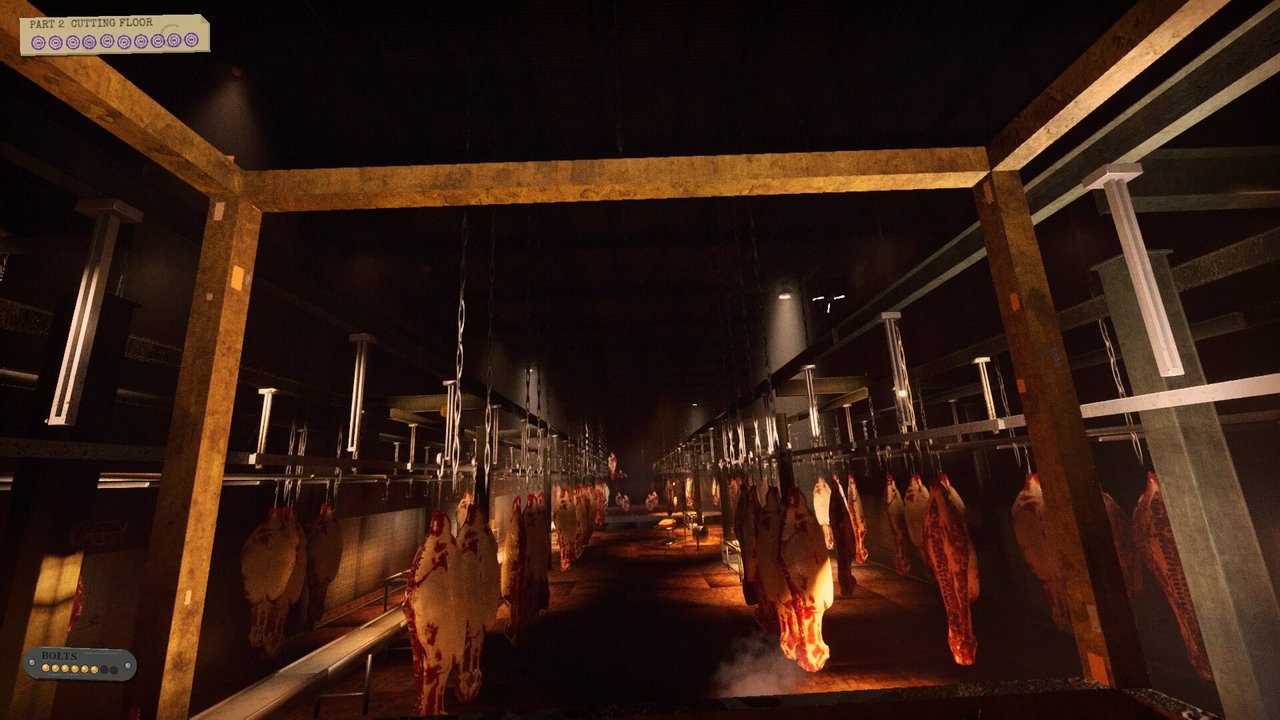
00:35 Don went to sleep and the director judged alone overnight. At 00:52 a rules check found that a slaughterhouse could read as animal cruelty: the kill floor became a cutting floor and no live animals appear.
03:00 Don: "why would there be a dairy blob in this place?" The director had a story reason for it. Don's question stood anyway, and the blob left with every other non-frank enemy.
11:25 Don's interrupt stopped all 16 helpers.
17:09 The ride audit counted 434 credibility flags, 122 high.
Failure 1. The start hang we never cured
From Saturday afternoon the packaged game sometimes died on its first frame, a GPU page fault in the shadow pass. We hunted it overnight. By Sunday 06:05 the count was 3 hangs in 95 launches, all inside 10 seconds. No rig reproduced it: 302 shadow returns in a stress switch and 9 fully cold launches all ran clean.
One trick came out of it. The graphics driver keys its shader cache on the exe's name, so a renamed exe starts fully cold (7,906 precompiles) and a renamed folder does not. That gave us a cold-start rig that touched nothing else on the machine.
At 08:01 Don chose an afternoon of digging. At 10:5x he cancelled it ("We don't need to dig") to give the laptop to the short cut. The hang ships behind a small launcher that restarts the game. The later tally was 2 hangs in about 265 launches.
Failure 2. The machine that lied
Tower 2 was the second Unreal machine. Two things went wrong there and cost most of Saturday evening. Its frame grabber returned corrupt frames and a checker passed them, until the director corrected the record at 18:40. Only the engine's own screenshot path is clean on that machine.
And the project sat on a 500 GB hard disk that was 0% idle. Game launches also waited behind compiles in the shared engine. Moved to an idle fast drive, a full compile fell from 269 s to 61 s and a level load from about 150 s to 8 s. At 19:45 every engineer was told to re-clone there.
19:52 Don: "lets do the shortcut but we really need to make sure we have wow moments and things that would impress the judges." He took the director's advice to cut the run to 8 to 9 minutes. Seven rooms stay in the project behind a flag.
The print
We stopped chasing the hang, and then the idea arrived.
06:05 We stopped chasing the start hang.
11:28 Don made the whole package one concept, the damaged print, 36 hours after he had removed film framing. The jam theme was Director's Cut. SPOILED is one battered print of a 1979 drive-in picture. It starts on film leader, counting down while the shaders compile. Cue marks flash before each hidden cut, and the cut lands as a splice. Pausing jams the projector and burns the frame at one edge.
A reel is missing from the theatrical run, so the first time through the print skips the fryer hall and stops on a REEL MISSING card. Clear the run and the end card offers one more row: run the Director's Cut, which restores the missing reel.
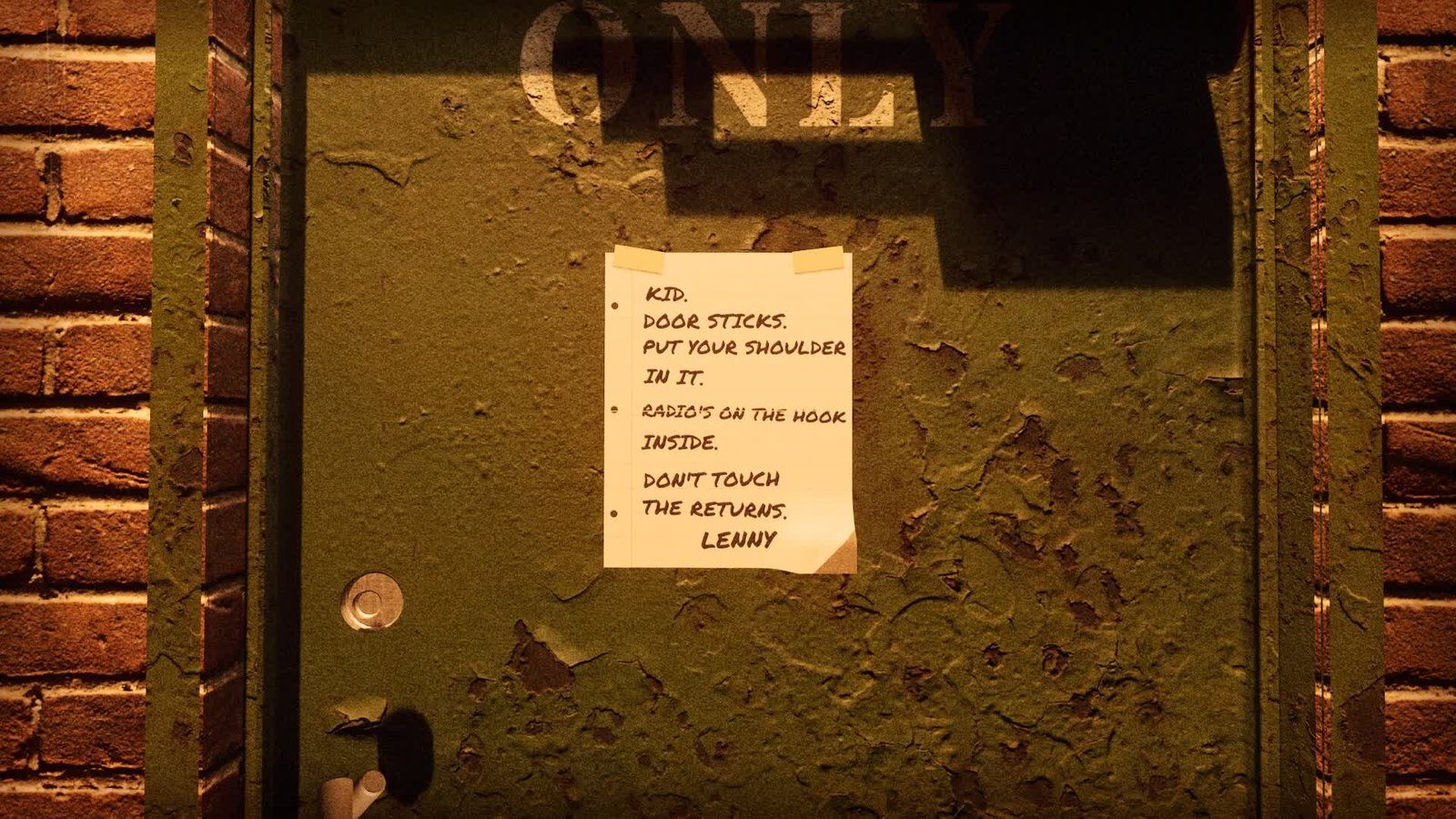


That hour a standing order started: new features ship off until they pass on packaged frames (see Reel 1).
The Wurst part
Declared
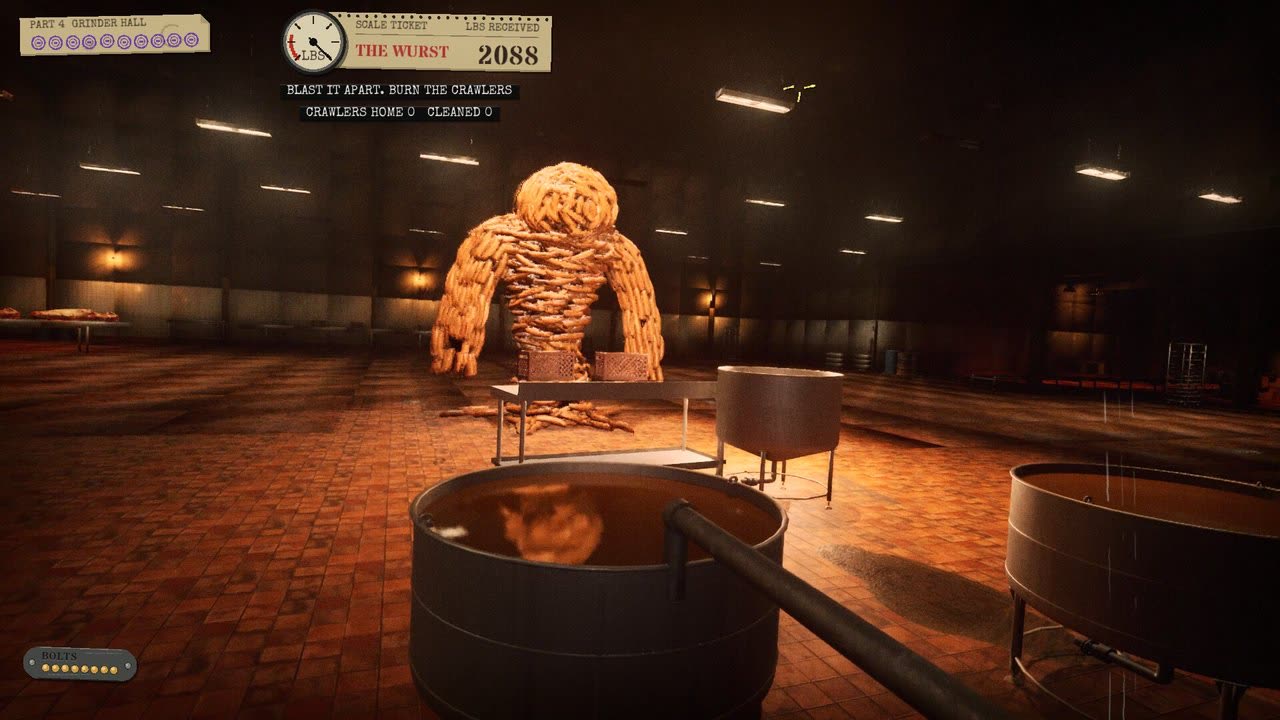
The Wurst's frank body method (code, six frank meshes, three frank textures, two materials) was first built in our own earlier project DEEP FRIED on Nov 10 and ported to SPOILED on Nov 14. Its layout, skeleton, motion, hood and fight logic were built during the jam. We declared it as pre-jam content on the submission form.
The last gate
The last afternoon: a reversal, a verdict from stand-in judges, and a miss we measured.
13:05 A painted poster look became the default, and at 14:26 Don reversed it. It had been the default for 81 minutes before he chose photoreal with the film print.
14:46 Don: "If we were watching / playing this on a giant projector in the dark, it should have the atmosphere and creepiness and mood..." That became the bar for the light pass and for the mix: deep blacks, one motivated key light per room, quiet before scares.
15:27 3W reached Don. At 15:47 he wrote: "right now it looks terribly janky, anything involving that kind of activity (things falling, barrels flying, catching fire, etc.)" Free physics went off. Every reaction is now an authored swap, such as a box to its crushed mesh, proven on a five-frame strip.
Stand-in judges Not real judges
A Claude model played three jurors who saw contact sheets only. Jury 4 scored the 3W package out of 5: fun and gameplay 3.0, theme 3.3, ambition 3.7, visuals 4.0. All three said the theme lived in the cards and not in the play. That is why the Director's Cut became a second run. Their scores are only as good as stills.
Failure 3. The mix we measured and still missed
No agent can listen, so we measured the mix against the projector test. On the 3W take the true peak was +1.8 dBTP with 147 samples at full scale, and 0 of 16 authored scares had the 12 dB of quiet before them that Don's bar asked for. The stock limiters let +2.2 dBTP through, so the audio engineer wrote a look-ahead limiter. It held -1.3 dBTP offline. Music came down 4 dB and beds 2 dB.
On the 3X take: 3 of 16 scares had their quiet, but the peak read +1.9 dBTP with 1,505 samples at full scale. The limiters did not hold. We say so here. The limiter is in the parts you can take.
17:04 The 3X gate passed. The package is 844 MiB and started 10 of 10 times.
Shift report
| Item | Before | After | Status |
|---|---|---|---|
| Full compile, tower 2 | 269 s | 61 s | Inspected |
| Level load, tower 2 | about 150 s | 8 s | Inspected |
| Mean frame rate | 42 fps | 66 fps | Inspected |
| Gate package starts | n/a | 10 of 10 | Inspected |
| First Shipping build vs the 1 GB limit | 1,003.1 MB | 844 MiB | Inspected |
| Start hang | 3 in 95 launches | 2 in about 265 | Not cured |
| Scares with 12 dB of quiet before them | 0 of 16 (3W) | 3 of 16 (3X) | Missed |
| True peak, mix | +1.8 dBTP (3W) | +1.9 dBTP (3X) | Missed |
| Ride audit flags | 434, 122 high | n/a | Found |
Before and after
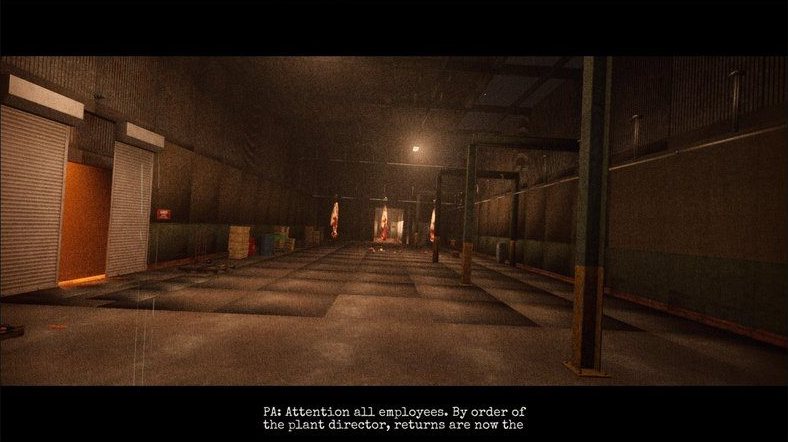
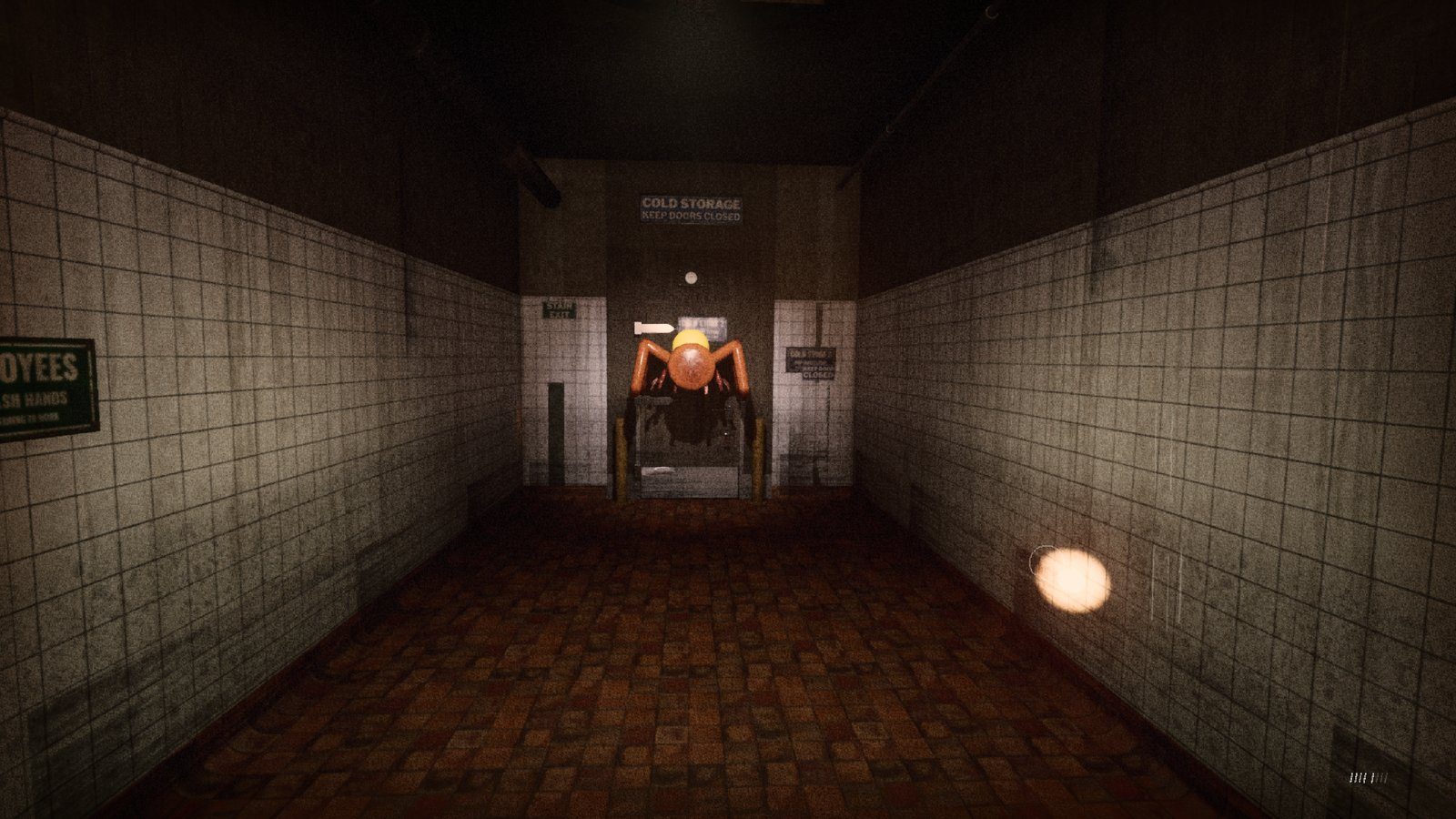
Set dressing from the scene pass. Same camera, same moment. Drag the slider.
Dock, ride camera at the push (6 s)
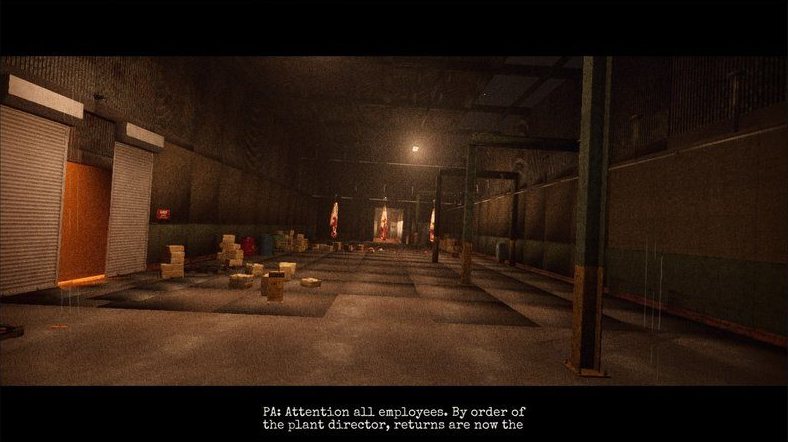
Dock, beef stop (11 s)
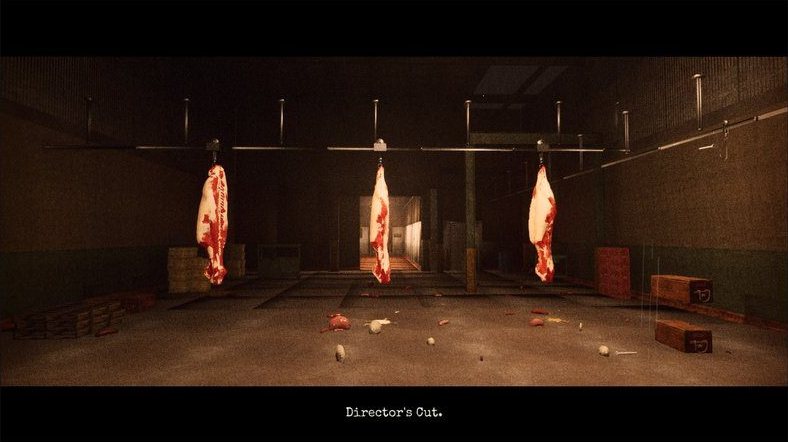
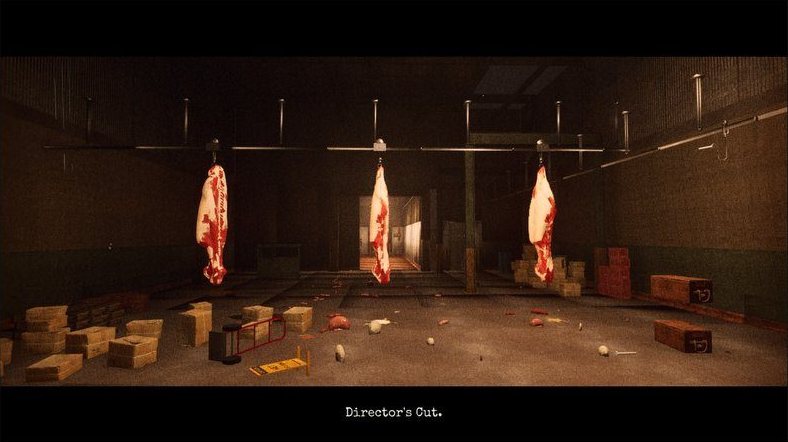
Cutting floor, from the cage (16 s)
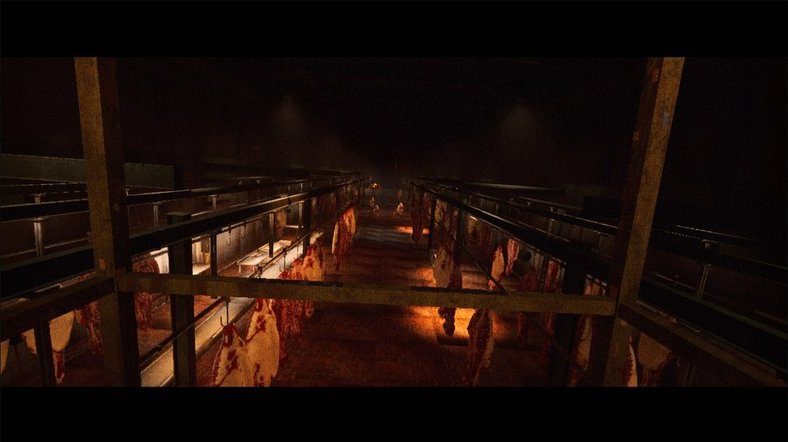
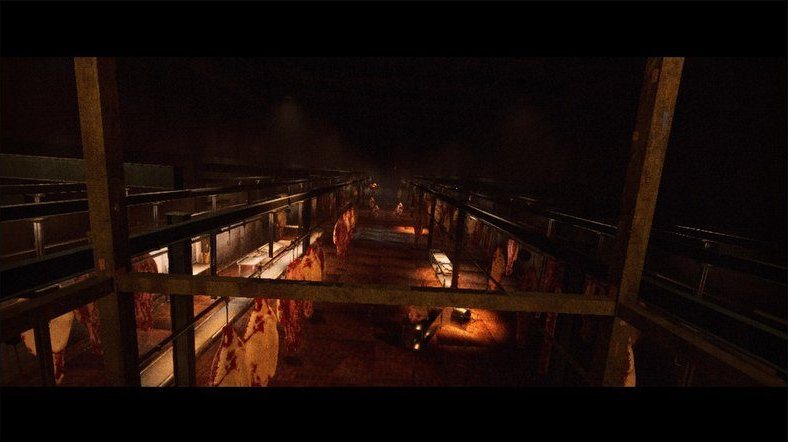
The default clean screen
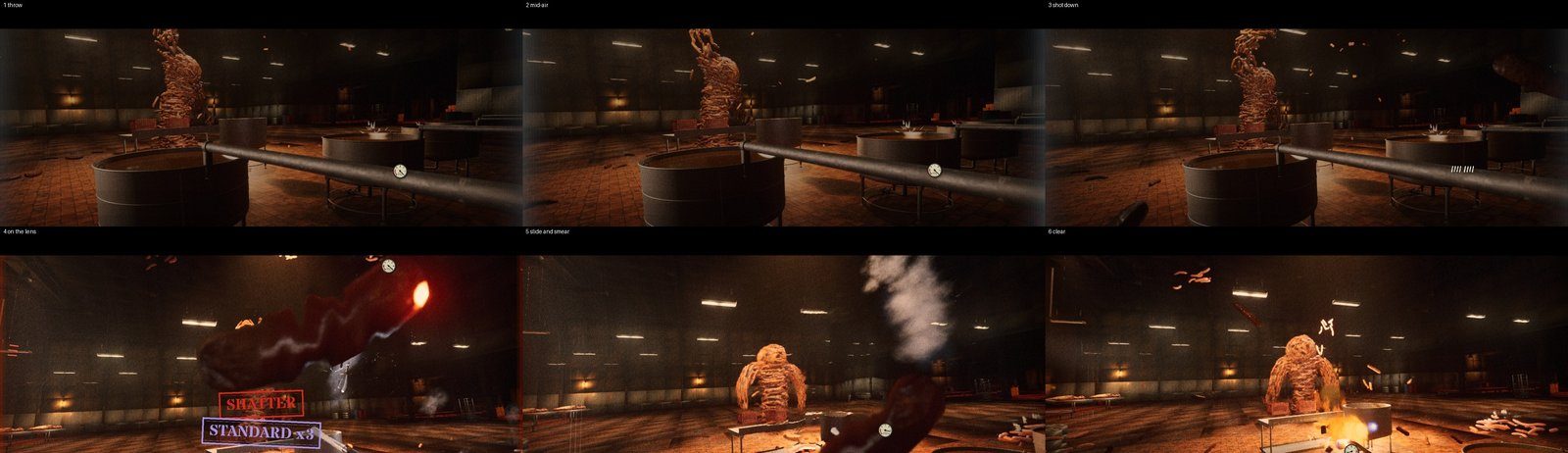
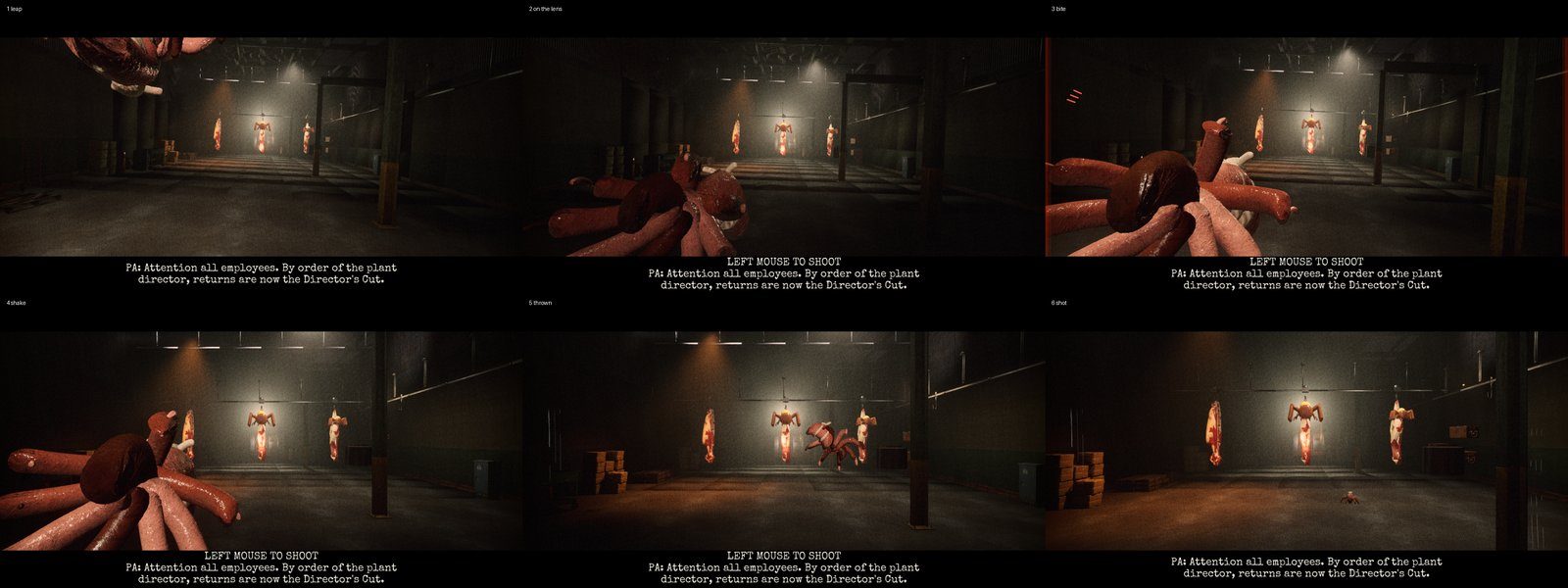
Pass strips
Every reaction that mattered got a strip like these, judged by the director on packaged frames.
What was cut
REEL MISSING
THIS PORTION OF THE PRINT HAS BEEN REMOVED
- The first game. Kid Katapult, thrown away at hour 37.
- Seven rooms of the route. They stay in the project behind a flag.
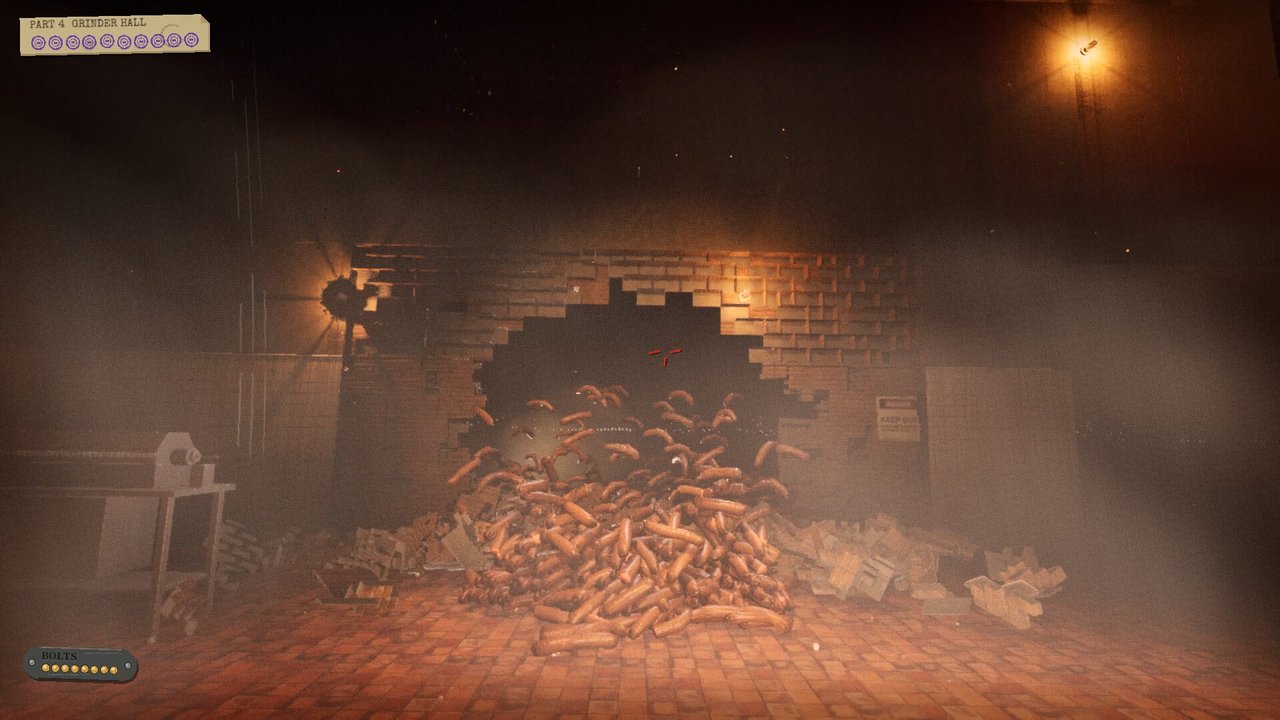
- The mid boss Sir Loin and every enemy not made of franks.
- A 3D Lenny, mostly a radio voice, at 83 MB for a distant figure.
- The boss's face, which read as cheesy.
- The sprayer and torch, once the bolt gun cleared the run alone. The bolt gun went from one of three tools to the only one after a bot never given the others cleared the run with 4.0 health. Free physics, black bars and default captions went on Don's notes.
- In-house floor and wall textures, which failed review because features repeated every tile.
- A test of building rooms from generated images. They beat our rooms on wear but tore apart inside about 2.5 m of the lens, so the wear came in as decals instead.
- Size. The first Shipping build measured 1,003.1 MB against the 1 GB limit; the 3X gate package is 844 MiB.
The human in the loop
Five of Don's notes, each quoted from decisions.md, with what it became.
FRI AFTERNOON"we can't have a game with a beef jerky dog."
SAT 03:00"why would there be a dairy blob in this place?"
SAT 19:52"lets do the shortcut but we really need to make sure we have wow moments and things that would impress the judges."
SUN 14:46"If we were watching / playing this on a giant projector in the dark, it should have the atmosphere and creepiness and mood..."
SUN 15:47"right now it looks terribly janky, anything involving that kind of activity (things falling, barrels flying, catching fire, etc.)"
Who decided what
Don decided the pivot, the ending, the cut, the look, the print as one concept, and the rebuild of the boss. He rated cards on a review board. He gave the director standing authority over monster design and roster at Sat 00:43, and at Sun 16:57: "the director originates improvements from here; Don vetoes." The agents decided staging, fixes, balance, what passed on frames, and every number on this page.
Some of Don's calls reversed the agents and some reversed his own.
Rules we learned the hard way
Each is quoted from decisions.md or the handoff, with the time it was written.
- Thu 00:52"The producer guessed clock times instead of reading the clock; times now come from
date." It happened again Thursday evening and again on Sunday. - Fri 02:10After a network outage cut off three workers: "workers commit as they go, so an outage costs minutes, not work."
- Fri 05:50Crossfades were written in display frames where the engine wants ticks, so every blend was a hard switch: "the packaged game was hiding pops the offline audit could not see."
- Fri 21:31"scripted Blender modelling tops out at 'decent toy' for organic creatures." Organic shapes moved to generated images, then image to 3D.
- Sat 03:32Don asked why Blender 5.3 was not in use. The director owned it ("I took the tool versions from memory").
- Sat 18:40Every frame from tower 2's frame grabber was a scrambled mosaic, and a checker had passed them. The handoff now reads "A checker passing is not a picture seen."
- Sun 06:05"count hangs per launch, not per package" and "compile Shipping the day before, not the day of."
- Sun 08:2xFrom Don's notes: "NOTHING POPS IN", "NOTHING PASSES THROUGH ANYTHING", "DEAD THINGS ARE STILL".
- Sun 12:03"today I passed looks on my own eye. From now a PASS needs a side by side with a named reference."
- Sun 12:38The studio's tested method for many-legged creatures and an earlier art lesson "were not applied to the jam."
- Sun 13:05"rooms were dressed from a stock kit for speed and never revisited."
Made before the jam, tools, credits
Made before the jam
There were 34 commits before Nov 12, the first on Nov 9. They hold agent rules and prompts plus the Unreal MCP settings and scripts. Packaging and capture scripts came then too, with small tests for lip sync and cloth. No gameplay or levels came from them.
The one item that is game content is declared in Reel 7.
Tools
Unreal Engine 5.9 with a C++ module and the Unreal MCP editor toolsets. Claude models from Anthropic for the director, lead, engineers, helpers and critic jury. Blender and ffmpeg. FLUX.2 klein for images, TRELLIS.2 for image to 3D, Kimodo for motion. Maya1 and Kokoro for voices, MOSS-SoundEffect for sound effects, ACE-Step for music, faster-whisper to check voice takes.
Credits
Every third party source is thanked by name in the game's credits, public domain work included: Poly Haven, Quixel Megascans (the sausage scan), the sound libraries, the font authors and the makers of each open model above. The full list and licenses are in the in-game credits and spoiled/CREDITS.md. Thank you to all of them.
Take this with you
Ten practices for anyone building with agents. Each one is paired with the incident that taught it, and the date.
- Make agents read the clock instead of guessing it.TAUGHT BY the producer guessing clock times in the log. Thu Nov 12, then again that evening and on Sun Nov 15.
- Have every worker commit as it goes.TAUGHT BY a network outage that cut off three workers. Fri Nov 13, 02:10.
- Judge the packaged build and not only the editor.TAUGHT BY crossfades that were hard switches, hiding pops the offline audit could not see. Fri Nov 13, 05:50.
- Look at the picture yourself, because a checker passing is not a picture seen.TAUGHT BY scrambled frames from a frame grabber that a checker passed. Sat Nov 14, 18:40.
- Take the tested method and the real tool versions from the docs, not from memory.TAUGHT BY Blender versions taken from memory (Sat Nov 14, 03:32) and a tested creature method not applied (Sun Nov 15, 12:38).
- Count failures per launch, and compile the shipping build the day before, not the day of.TAUGHT BY the start hang, counted per package at first. Sun Nov 15, 06:05.
- Ask for a side by side with a named reference before anything counts as passed.TAUGHT BY looks passed on one person's eye. Sun Nov 15, 12:03.
- Give each helper its own clone and branch, and keep one owner for the compiler.TAUGHT BY game launches waiting behind compiles in a shared engine, until a full compile fell from 269 s to 61 s. Sat Nov 14, evening.
- Ship new features behind flags, default off, until they pass on packaged frames.TAUGHT BY the freeze order: the last package shipped only what had passed on frames. Sun Nov 15, 11:28.
- Write each human note down as a dated rule, and publish what you could not fix.TAUGHT BY the 3X mix, where the limiters did not hold and we said so. Sun Nov 15.
Take the parts
BYOK Games is sharing these as plain text files, copied from the game's repo as they are. Shared by BYOK Games under the MIT License
- SPLimiter.hSPLimiter.cppThe look-ahead true-peak limiter, written on the last afternoon. It holds every output sample, and the 4x inter-sample peaks between them, under the ceiling. Read what it did and did not fix in Failure 3.
- SPNoclip.hSPNoclip.cppThe audit that counts enemies passing through geometry, in seconds on screen. Log-only, so it cannot change the game it measures.
- GATE.mdA one page build gate: ten starts, bots at three skill levels, frame rate lines, and one full take whose log travels with the package. Written from the lists we used.
More source notes and assets follow after the jam.
The last ninety minutes
Don played the build, and it was not what our checks said it was.
15:24 An in-house version of the bolt gun's shot replaced the library sound. Nobody listened to it.
19:35 Don recorded his voice: 14 radio lines for Lenny and two waitress lines that end the credits ("Hey hon, what'll it be?" and "Any sausage? First of the month shipment just came in."). A speech-to-text model on the laptop matched each take to its line, and nothing left the machine.
20:05 Package ship14 was ready, and Don played it through the last hour. He wrote: "there's no force, nothing happens to the bad guys or the Wurst," and "the action is the part lacking the most." The shot sound was terrible, unseen attackers did damage, and shots gave no feedback. Aim was slow. The menu TV was a still.
20:28 This page went live. By the 21:05 note the entry was in, 13 minutes before the deadline.
What the playtest found, and what we did
Fixed in ships 15 to 17All 96 swapped sounds went back to the library versions. The arcade HUD is the default again, since the clean one hid hit feedback. Mites bite once. Aim is 1.5 times faster. The bolt is thicker and kicks the camera, hits shake the screen, and launches get a warning flash. The hurt frame is stronger, shed franks fly harder, the grain is finer, the menu TV plays its real clip, and Don's voice lines are in.
Not fixedEnemies do not flinch or flash when hit, and a form break has no hit stop. The door frame still flickers, and the Wurst has none of Don's lines. Nobody saw a frame of ships 15 to 17 before upload; we had logs and start checks only.
The lessonPut a playable build in the owner's hands on day one. Our frame sheets and bots passed things that a person found wrong in minutes.
Numbers
Open the books
The raw working record of the jam, as readable pages.
These are the files Don and the agents worked from during the jam: every ruling, the director's hourly notes, the list of what broke, the usage meter, the handoffs, the playbooks and the voice script. They are the working record. They were not written for an audience, so they are terse and full of ticket and machine names, and they keep our wrong guesses and corrections as they happened.
We scrubbed them for private details only (an email, a home folder name, a legal name, the path of Don's private voice recordings folder, an IP address) and cut one line about another entrant's entry and one line naming an outside person. Each cut is marked in the text. Everything else is as written. The scrub was a script plus a search, so a miss is possible. It is text only: no images, and none of the voice recordings.
This section and the last ninety minutes reel were added on the night of Nov 15, after the entry went in. The jam did not have this page when we submitted. We are saying so plainly.
| File | What it is | Words | Link |
|---|---|---|---|
| decisions.md | Every ruling, with Don's own words marked. | 33,111 | Open |
| notes.md | The director's hourly notes. | 29,786 | Open |
| failures.md | The blooper list: what broke and how it got fixed. | 14,256 | Open |
| usage-pace.md | AI usage against a budget, hour by hour. | 6,022 | Open |
| timing.md | How long each kind of job took. | 5,341 | Open |
| trials.md | Head to head trials of models on the same job. | 711 | Open |
| GLASS-BOX.md | An earlier Glass Box write-up, from when the game was still Kid Katapult. | 4,663 | Open |
| DIRECTOR-HANDOFF.md | The director's state blocks, written so the next session could pick up. | 15,133 | Open |
| PLAYBOOK.md | The pre-jam playbook for the first hours. | 2,901 | Open |
| RISKS.md | The pre-jam risk list. | 1,655 | Open |
| SCHEDULE.md | The pre-jam schedule. | 2,926 | Open |
| UNREAL-AGENT.md | Standing rules for any agent working in Unreal. | 970 | Open |
| MCP-RUNBOOK.md | How the agents drove the Unreal editor. | 5,433 | Open |
| LEVEL-CONTRACT.md | What a level has to provide so code and art can meet. | 1,090 | Open |
| PLAYBOOK.md | The repo playbook: lessons and method, updated as we went. | 6,435 | Open |
| SCRIPT_FOR_RECORDING.md | Every voice line, as a script for the recording session. | 4,734 | Open |
| VOICE-GUIDE.md | How the voices were meant to sound. | 1,022 | Open |
| CREDITS.md | Credits and licenses for every third party source. | 2,543 | Open |
| SOURCED-ASSETS.md | The list of sourced assets and what each one is used for. | 1,995 | Open |
| WURST2_PROVENANCE.md | Where The Wurst's body came from. | 1,024 | Open |
| SUBMISSION_FORM_ANSWERS.md | Working answers for the jam submission form. | 3,576 | Open |
| REPORT.md | A short research report on an alternative build route. | 531 | Open |
| THEME, PICK, TOP10, PITCHES, PITCHES-R2, take-KK | The theme, the pitches and the pick of Kid Katapult (6 files). | 2,625 | Open |
| scores-*, scoresR2-*, takes-* | The first-round and round 2 takes, and every judge's scores (13 files). | 11,529 | Open |
| DESIGN.md | The Kid Katapult design page. | 1,091 | Open |
| STORY.md | The story bible for Thunder on the Midway. | 1,190 | Open |
| ACTIONS.md | The action bible: every stunt action and its gaps. | 5,951 | Open |
| ACTIONS-PLAN.md | The action plan, with proof tests. | 7,806 | Open |
| CONTENT-PLAN.md | Sets, longer takes, walk-throughs and beats. | 845 | Open |
| FUN-UX-PLAN.md | The fun audit and 19 tickets. | 1,993 | Open |
| BACKLOG.md | The machine and ticket backlog. | 5,901 | Open |
| ROSTER.md | The crew and equipment roster. | 707 | Open |
| BEATS, BRAWL-CONTACT-PLAN, SEAMS, WALKTHROUGH, WIRING-PLAN | Plans for the three takes (5 files). | 14,563 | Open |
| RETARGET-AB, sets README, voice results, fable-editbay | The retarget A/B, sets, voice bake-off and model trial plan (4 files). | 6,354 | Open |
| *_IMPORT.txt | Import notes per cast, costume and lip sync batch (5 files). | 4,110 | Open |
| gallery.html | The pictures: concepts, key art, game frames, workflow diagrams, how-tos, oddities and Kid Katapult (not a raw file). | n/a | Open |
The last row is not a raw file. The Pictures, Finally is a gallery of concept art, key art, game frames, workflow diagrams, how-tos and oddities, added after the entry went in. The 13 rows above it are the Kid Katapult records. Take 37: The Stunt That Went Wrong tells their story, with a timeline and a blooper reel, and links every one.
How the agents were run
Drawn from notes.md and usage-pace.md. Where a bullet rests on another raw file, it links that file.
- One director. A single director session turned Don's notes into dated rulings and tickets. On Saturday at 16:42 Don switched that session to Fable 5.2, after a handoff file was written for it (DIRECTOR-HANDOFF.md).
- One lead engineer. The handoff calls the laptop the lead's only compiler and GPU, and says helpers never write into or build in the shared laptop copy. They worked in their own clones and pushed branches for the lead to merge (DIRECTOR-HANDOFF.md).
- Cheaper helpers for scoped jobs. Haiku helpers did the reading and research. Sonnet workers took scoped tickets that came with a check. Opus helpers took the costume and look passes that needed judgment.
- Bots at three skill levels. Packaged builds were played by bots of three skills for balance and timing. The notes quote the average bot and the sharp bot, each with its clear time and end health.
- A rule for the owner's MetaHuman character. No frame that shows the character Lenny is ever shown to an AI model. The notes mark such stills as held for Don alone ("no model has looked at them; they are for Don"). Don's full playthrough went to him "viewed by no one". The director judged only takes made with the character absent, and a frame sheet was opened only after its log was checked for that (the notes say "each log checked for Lenny absent"). The ruling itself is in decisions.md.
- An hourly usage row. Each hour usage-pace.md logs the share of the weekly quota used, the pace line, the context size in thousands of tokens, and which workers were running. The ration test before the jam closed about 3 points under its line.